Welcome to the first of what will hopefully be an ongoing series looking at the other side of the
Komen 3 Day for the Cure: the science that we're raising money for. I have a number of posts planned both about how biomedical research is done in general and about breast cancer science specifically. However, before I get into those topics, I think it's important that I let everyone know what my background in science is that I think qualifies me to talk about these things. Let me say right here, I am not an expert on breast cancer. But I am a knowledgeable and experienced biomedical scientist with something to say about biomedical research and breast cancer science. In this post, I hope that I can explain how I got to this place.
Growing up, I wasn't one of those science geek kids. I never had a chemistry set, a microscope or even a rock tumbler. I preferred to climb trees, play sports, read books and take dance classes. I was an endlessly curious kid that wanted to know as much as possible about everything, a trait I still have today. In high school, that intellectual curiosity led me to take as many science classes as were available to me. While I took Earth Science, Chemistry and Physics, it was Biology that captured my imagination and it was Biology that I decided to pursue in college.

I did my undergraduate studies at
Ithaca College (IC), where I majored in Biology. For those that don't know, Ithaca College is a small, liberal arts college located in Ithaca, New York. They are known primarily for their music, communications and sports medicine programs. When I matriculated at IC, their science programs were just starting to grow in esteem, Biology most especially. One of the great advantages that a small college like IC has over a big university is the opportunities that undergrads have to do actual lab research. At a large university, the undergrads are often relegated to washing dishes and making solutions while the graduate students and post docs get to do all the exciting stuff. At Ithaca College, I was able to join a lab in the second semester of my freshman year. My lab advisor,
Dr. Jean Hardwick, was (and still is) a fantastic mentor and with her guidance, I was able to run my own research project for the duration of my time at IC. I presented my work at a number of
regional and
national conferences and had my work published in a
major science journal, something few undergrads get the opportunity to do. That early experience has been invaluable in shaping who I am as a scientist, not just in the lab but in the scientific community at large.
While at IC, I became interested in two areas of Biology: Neuroscience and Cellular and Molecular Biology. In Jean's lab, I studied the interactions of the Nervous System and the Immune System to control cardiac function. What particularly interested me about this work was the interplay of multiple body systems. It was fascinating to see how completely distinct biological systems use remarkably similar signaling pathways and protein components to keep everything working in the human body. The universality of biological systems is something that still interests me today.

While at Ithaca College, I was presented with an opportunity to spend eight months interning at
Syngenta, an agricultural biotechnology company in
Research Triangle Park in North Carolina. While plants and agriculture were certainly not something I sought out to study, the opportunity to do research in a non-academic setting was too interesting to pass up. In addition, because I worked in the Biochemistry group, I was able to learn more about molecular biology in very different ways from what I was used to in my lab at IC.
While I learned a lot about biochemisty at Syngenta, I learned even more about "for profit" science and the biotechnology sector. While academic labs favor scientists with a broad range of scientific knowledge and experience, biotech companies emphasize specialization. At a biotech company, you are one piece of a very large puzzle working towards goals that are laid out for you. You are expected to perform your job well and then hand it off to the next person to continue the project. You very rarely are in charge of a whole project from start to finish, something that I found hard to get used to. The advantage of working in an "industry" setting, of course, is that money isn't really a factor. Academic labs have to fight tooth and nail for every dollar they get. Biotech labs generally don't have to worry about their funding situation. At Syngenta, I was able to use cutting edge high throughput screening technology that an academic lab would never be able to afford. Access to technology is almost always an advantage when it comes to moving science forward, making industry labs an important and critical piece of the scientific community at large.

Following graduation from Ithaca College in 2002, I enrolled in the
Neuroscience PhD program at
Emory University in Atlanta, Georgia. A major factor for me in deciding to study Neuroscience was that the Nervous System doesn't work in a vacuum. The Nervous System is primarily responsible for keeping every other system in the body working properly and in sync. Therefore, understanding the common components and signaling pathways is incredibly important to studying the Neuroscience. Also, it has to be said, brains are just plain cool.
For my doctoral studies, I have been studying Alzheimer's disease (AD). I chose to work on a specific disease because I was really motivated by doing work that had direct ramifications for patients and their families. Scientific research can be very isolating and frustrating. Remembering the real life applications of our work makes the endless days and weeks of failed experiments a bit easier to handle. In particular, the bulk of my work has been on characterizing one of the earliest changes that occurs in the brain during the onset of AD. Recognizing biological changes that precede memory loss and cognitive decline could one day lead to earlier detection and better treatments that could delay or even eliminate the onset of AD to provide patients with as many years of quality life as possible. This work has also led to one
first author publication with at least one more planned for this coming year.
Unlike at Syngenta, pursuing funding sources for my research has become an important part of what I do in the lab. When I first enrolled at Emory, my work was funded directly by the university and the Neuroscience program. Shortly after I finished my required courses and qualifying exams, I was lucky to secure a small grant from a small charitable foundation called the
Luttrell Foundation. That grant covered my work for three years and was invaluable as I got my feet under me in the lab. Finally, my last three years of research has been funded by NIH in the form of an
NRSA grant. I am planning to discuss the various ways that scientific research is funded in a future post, but suffice it say, I've experienced a lot of funding circumstances in my time as a lab rat.
Throughout my life, one thing has always remained consistent: my intense curiosity to learn as much as possible about as much as possible. With science, I have had the opportunity to ask really interesting questions and to pursue those answers in really interesting ways. I've also been able to do work that I hope will benefit society in the years and decades to come. Finally, because of my understanding of basic science principles, I am able to understand other areas of scientific research discovery at a much deeper level.
When my mom was first diagnosed with breast cancer, my interests understandably swung over to cancer science. While I haven't formally studied breast cancer, I've familiarized myself with the science of breast cancer. I passionately follow new developments and emerging debates. I consider helping others who aren't as well versed in science as I am to understand these issues to be an important responsibility. The better that those advocating for biomedical research funds understand what they're actually advocating for, the more compelling their arguments become. I hope that through my future posts, I can help everyone to better understand the science of breast cancer and why scientific research is so important.
Me and my microscope
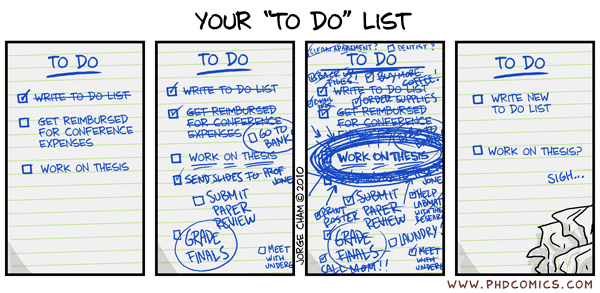
 First of all, I wanted to extend my apologies for my extended blogging absence. I didn't intend to disappear for so long without an explanation. For those of you who don't know, in addition to my work raising money for breast cancer research and training for the Breast Cancer 3 Day for the Cure, I am also a graduate student working towards my PhD in Neuroscience. In fact, I have been a graduate student working on my PhD for far too long, for a variety of reasons. Ultimately, it has been my efforts towards changing that status and completing my degree once and for all that has kept me away from this blog for the last few weeks. Following a very stressful but successful meeting with my thesis committee members and my advisors, I was finally given permission to wrap up my research and focus on writing both my doctoral dissertation and a final research paper to be published in the near-ish future.